



Introduction
Imagine a world where businesses can understand customer needs before customers even search for a product. Imagine advertisements that match individual interests, artificial intelligence that helps create marketing campaigns, and websites that provide personalized experiences to every visitor. This is the direction in which digital marketing is moving.
Digital marketing has become an essential part of modern business. Companies use search engines, social media, websites, email, and online advertising to reach customers and promote their products. As technology continues to develop, the future of digital marketing will bring new opportunities for businesses, students, entrepreneurs, and marketing professionals.
In this blog, we will explore the future of digital marketing, emerging technologies, career opportunities, and the skills marketers will need to succeed.
1. Artificial Intelligence Will Transform Marketing
Artificial intelligence (AI) is one of the most important technologies shaping the future of digital marketing. AI tools can help marketers generate content ideas, analyse campaign performance, automate repetitive tasks, and understand customer behaviour.
For example, a business can use AI to identify patterns in customer interactions and improve its marketing strategy. AI-powered chatbots can also answer common questions and help customers find information quickly.
In the future, AI may make marketing workflows more efficient by helping businesses personalize content, analyse large amounts of data, and make faster decisions.
However, human creativity will remain important. Successful marketers will combine AI technology with original thinking, emotional understanding, and effective communication.
2. The Future of Search Engine Optimization (SEO)
Search engine optimization will continue to play an important role in digital marketing. Businesses want their websites to appear when potential customers search for relevant information, products, or services.
However, SEO strategies are evolving as search engines introduce new features, including AI-generated answers and conversational search experiences.
Future SEO strategies will focus on creating helpful, original, and trustworthy content that answers users’ questions. Website speed, mobile usability, clear navigation, and relevant information will also remain important.
Marketers will need to understand search intent rather than simply repeat keywords throughout an article.
For bloggers and website owners, this means publishing useful content that solves real problems and provides readers with information they can trust.
3. Social Media Marketing Will Become More Interactive
Social media platforms have changed how businesses communicate with their audiences. Platforms such as Instagram, Facebook, YouTube, and LinkedIn help brands share information, promote products, and build relationships with customers.
In the future, social media marketing will continue to evolve through short-form videos, creator partnerships, interactive content, and social shopping experiences.
Businesses may increasingly use polls, live sessions, demonstrations, and behind-the-scenes videos to engage their audiences.
For digital marketers, understanding audience interests and creating authentic content will be more important than simply posting frequently.
Brands that build communities and respond to customer questions can develop stronger relationships with their audiences.
4. Personalized Marketing Will Improve Customer Experiences
Imagine visiting a website that recommends products based on your interests or receiving an email containing information relevant to your previous interactions with a business.
Personalized marketing uses customer preferences and permitted data to make communication more relevant.
In the future, businesses will continue exploring ways to provide personalized recommendations, relevant offers, and more useful customer experiences.
However, personalization must be balanced with privacy. Businesses should handle customer information responsibly, follow applicable data protection laws, and respect consent and communication preferences.
When used appropriately, personalization can help customers discover relevant products and services without overwhelming them with unnecessary messages.
5. Video Content Will Continue to Grow
Video has become a popular way to communicate information online. Businesses use videos to demonstrate products, explain services, share customer stories, and educate their audiences.
Short videos can attract attention quickly, while longer videos can explain complicated topics in greater detail.
In the future, video marketing will remain an important opportunity for brands, content creators, and digital marketing professionals.
Businesses may also experiment with interactive videos, live shopping, and AI-assisted video production.
People who learn video editing, storytelling, scriptwriting, and content planning can develop valuable skills for the changing marketing industry.
6. New Career Opportunities in Digital Marketing
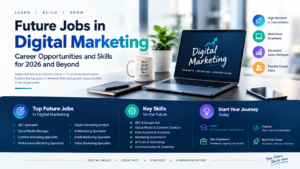
The future of digital marketing offers several career paths for people with different interests and abilities.
Some popular career options include:
- SEO Specialist: Helps improve website visibility in search results.
- Social Media Manager: Plans content and manages social media communities.
- Content Creator: Produces blog posts, videos, graphics, and other digital content.
- Performance Marketing Specialist: Manages paid campaigns and measures their results.
- Digital Marketing Analyst: Studies campaign data and identifies opportunities for improvement.
- Email Marketing Specialist: Creates and manages email campaigns.
- AI Marketing Specialist: Explores how AI tools can support marketing activities.
The availability of jobs and salary levels will depend on experience, location, industry, and practical skills.
Students can prepare for these opportunities by learning marketing fundamentals, building websites, completing practical projects, and developing a portfolio.
7. Essential Skills for Future Digital Marketers
Technology alone will not guarantee success in digital marketing. Professionals will need a combination of technical knowledge, creativity, and business understanding.
Important skills include SEO, content writing, social media management, data analysis, paid advertising, and marketing automation.
Understanding AI tools will also help marketers work more efficiently. However, they must know how to check AI-generated information, protect customer data, and maintain content quality.
Communication and critical thinking are equally important because marketers need to understand customer problems and explain how products or services can help.
Continuous learning will be essential as platforms, technologies, and customer expectations change.
8. Challenges in the Future of Digital Marketing
Although digital marketing offers exciting opportunities, it also presents challenges.
Competition for online attention is increasing, making original and useful content more important. Changes to search engines and social media algorithms can also affect marketing performance.
Businesses must address privacy concerns and use customer data responsibly. They must also avoid depending entirely on automation or publishing large quantities of low-quality AI-generated content.
Another challenge is measuring success. Likes and views may indicate engagement, but businesses must also consider leads, sales, customer satisfaction, and return on investment.
Digital marketers who can adapt to these challenges will be better prepared to develop effective strategies.
Conclusion
Imagining the future of digital marketing reveals a world where technology, creativity, and customer experience work together. Artificial intelligence, evolving search technologies, social media, personalized communication, and video content will continue to influence how businesses connect with people.
At the same time, successful marketing will still depend on understanding customer needs, building trust, sharing valuable information, and measuring meaningful results.
For students and aspiring professionals, this is an excellent time to begin learning digital marketing. Start with the basics, practise your skills, explore new tools, and work on real projects.
The future of digital marketing will not belong only to people who understand technology. It will belong to those who know how to use technology creatively to solve problems and build meaningful connections with customers.